Guide to Gas Stations in Iceland: Payments & Self-Service Tips
Learn how to use gas stations in Iceland, pay at self-service pumps, avoid 25,000 ISK fuel holds, choose the right fuel, and plan refueling for remote areas and the Highlands.
Fueling a rental car, campervan, or motorhome in Iceland is generally easy once you understand how the pumps work. Most stations accept cards, many operate as unmanned self-service locations, and the major fuel networks are spread across the country's main towns and routes.
The main challenge for visitors is not finding fuel around Reykjavík or along the Ring Road—it is knowing when to fill up before entering a remote area. Fuel stations become much less frequent in the Westfjords and other sparsely populated regions, while the Highland interior has very limited fueling infrastructure. Plan your fuel stops in advance rather than assuming the next station will be nearby.
There is also one Icelandic gas-station quirk that can surprise travelers: selecting "Fill Tank," "Fill Up," or a similar option at a self-service pump can place a temporary authorization hold of up to 25,000 ISK (around $200 USD) on your card. You are normally charged for the fuel you actually use, but the temporary hold can reduce your available balance until your bank releases it.
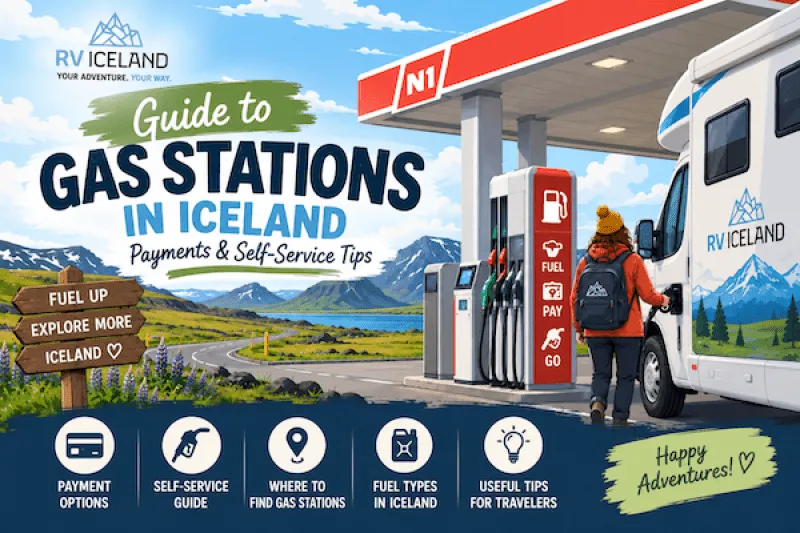
Gas Stations in Iceland: Key Takeaways
Navigating Icelandic gas stations requires understanding automated self-service pumps, card payment rules, and regional fuel gaps. Here are some quick takeaways worth knowing before hitting the road:
- Main payment method: Credit and debit cards are the easiest option. Have a card with a PIN for unattended pumps.
- Fuel types: Most rental cars use 95-octane gasoline or diesel. Check your rental vehicle before fueling.
- Fuel prices: Prices change frequently and vary by station and region. Check current prices before long drives.
- Self-service: Common throughout Iceland, including many 24/7 locations.
- "Fill Tank" warning: A full-tank selection can authorize up to 25,000 ISK (~$200) temporarily on your card.
- Prepaid fuel cards: Available from major chains and useful if your card does not work at an unmanned pump.
- Ring Road: Fuel is relatively easy to find, but you should still refuel before long remote stretches.
- Westfjords: Stations are concentrated in towns, and gaps can reach roughly 100–200 km depending on the route.
- Highlands: Do not rely on finding a normal fuel station once you are deep in the Highlands. Start with a full tank and plan your route carefully.
- Motorhomes: Larger vehicles consume more fuel and may require additional services such as fresh-water refill and waste disposal.
For current fuel costs, see our guide to gas prices in Iceland. Fuel prices fluctuate, so treat any published price as a snapshot rather than a fixed rate.
Map of All Gas Stations in Iceland
A gas-station map is one of the most useful tools to have before starting a long Iceland road trip. Use it to identify where you can refuel before entering remote areas, rather than waiting until the fuel warning light comes on.
The major networks provide their own station locators, including N1's station finder, Olís's station map, and Orkan's station locator. Station services vary, so check the individual location if you need a shop, restroom, water refill, toilet dump, car wash, or other facility.
When planning your route, make sure to not only look at the distance between stations, but also whether the station is staffed, whether self-service is available, what fuel types it sells, and whether it is open when you expect to arrive.
Essential Rules for Fueling in Iceland
Fueling in Iceland is straightforward, but a few rules will make the experience much easier:
- Know whether your rental uses gasoline or diesel before you reach the pump.
- Keep a payment card with a working PIN available.
- Do not wait until the tank is nearly empty in remote areas.
- Use the station's self-service system when the shop is closed.
- Be cautious with the "Fill Tank" option because of the temporary authorization hold.
- Check the next available fuel stop before leaving a major town.
- Do not assume a remote station will have the same opening hours or services as a city station.
- Fill up before entering the Highlands because fuel availability is extremely limited there.
Most travelers can complete an Iceland road trip using cards rather than carrying large amounts of cash.
Diesel vs. Petrol: How to Select the Right Fuel for Your Rental?
The first thing you need to know is what fuel your rental vehicle uses. Never guess based on the color of the pump handle alone. Colors can vary between fuel networks and individual stations.
At Orkan, for example, diesel has a black handle while 95-octane petrol has a green handle. Other colored handles can be used for different fuel products or heavy-duty vehicles.
Look for the fuel name and octane rating displayed on the pump:
- Bensín 95 / 95 okt = 95-octane gasoline/petrol.
- Bensín 98 / 98 okt = 98-octane gasoline/petrol.
- Diesel / Dísel = diesel.
- Litað dísel / Colored Diesel = marked diesel intended for specific uses; do not put it in a rental vehicle unless your rental company specifically tells you to do so.
- AdBlue = a separate fluid used by some diesel vehicles. It is not fuel.
Icelandic fuel stations commonly list 95-octane gasoline and diesel, while some larger stations also offer 98-octane gasoline, AdBlue, and other products.
If you are unsure, check the fuel label inside the rental vehicle or ask the rental company before fueling.
Full-Service Stations vs. Unmanned Self-Service Pumps
You will encounter two main types of fuel stops in Iceland.
Staffed stations have an attendant, shop, and often additional services such as food, restrooms, coffee, tire inflation, car wash facilities, or vehicle supplies. During staffed opening hours, you can go inside and ask for assistance.
Unmanned self-service stations allow you to fuel the vehicle yourself using the payment terminal at the pump. These are particularly useful outside normal business hours and are common across Iceland. Individual stations have different facilities and schedules, so check the station listing rather than assuming every location is identical.
For visitors, staffed stations can be especially convenient if you are unfamiliar with Icelandic pumps or if your foreign card does not work at an automated terminal.
Finding Gas Stations in Remote Regions
Fuel planning becomes increasingly important as you leave Reykjavík and the larger towns.
Along the main Ring Road, fuel stops are generally available in towns and at regular intervals, but the gaps become much longer in sparsely populated regions. In the Westfjords, for example, fuel stations are concentrated in towns such as Ísafjörður, Patreksfjörður, and Hólmavík, with long stretches between them.
A good rule of thumb when traveling through remote regions is if you see a gas station and your tank is around half full, stop and fill up the tank.
Do not plan your trip around the assumption that a small rural station will always be open. If a station has limited hours, a technical problem, or no fuel available, the next option may be a long way away.
In the Westfjords, gaps of 100 km or more are possible, and some routes can involve significantly longer stretches between reliable fueling points.
Motorhome & Large RV Considerations in Iceland
Motorhomes and large campers need more fuel than ordinary rental cars, and their larger dimensions can also make fueling more demanding.
Before setting off, check:
- Your vehicle's fuel type and tank capacity.
- Where the next suitable fuel station is located.
- Whether the station has enough space for a large vehicle.
- Whether the station offers diesel suitable for your vehicle.
- Where you can refill fresh water.
- Where you can empty wastewater or portable toilets.
- Whether the station has a large-vehicle access area.
Some larger Icelandic stations provide services specifically useful to campers and motorhomes. For example, Olís lists portable-toilet emptying at selected stations, while N1 locations can offer services including fresh-air facilities, toilets, gas, AdBlue, and motorhome-related waste disposal.
However, not every gas station is a motorhome service point. A fuel station may have a pump but no water refill, dump station, or suitable parking area for a large RV.
Plan your fuel, water, and waste stops separately.
How to Pay at Icelandic Fuel Pumps?
Iceland is highly card-oriented, and credit and debit cards are the normal way to pay for fuel. Visa and Mastercard are widely accepted, while payment options can vary between individual unmanned stations. Contactless and mobile payments are also increasingly common.
The process at an automated pump is generally:
Insert, tap, or present your payment card according to the machine's instructions.
- Enter your PIN if requested.
- Choose the pump or fuel type.
- Select the amount you want to authorize.
- Remove the nozzle.
- Fuel the vehicle.
- Return the nozzle.
- Collect your receipt if available.
If the machine offers a specific amount such as 5,000 or 10,000 ISK, selecting a defined amount can help you avoid the larger authorization associated with "Fill Tank."
For a broader overview of currency and payment methods in Iceland, including cards, cash, contactless payments, and fuel stations, see our payment guide.
The 4-Digit Credit Card PIN Requirement
A card with a PIN is highly recommended for driving in Iceland. Many self-service fuel terminals require card verification before allowing you to pump fuel.
If your card uses a different PIN setup or does not allow PIN transactions, do not assume it will work at every unmanned pump.
Before your trip:
- Confirm that you know your card PIN.
- Make sure your bank allows international transactions.
- Bring at least two payment cards if possible.
- Keep a prepaid fuel card as a backup if you are traveling into remote areas.
If a card is rejected at an unmanned pump, try another card or use a staffed station.
The "Fill Up" Option: What You Need to Know
This is one of the most important things for visitors to understand.
When you select "Fill Tank," "Fill Up," or a similar full-tank option, the pump may place a temporary authorization of up to 25,000 ISK (approximately $200 USD) on your card. This is not necessarily the final amount you will pay. The final transaction is based on the fuel you actually pump, while the authorization is released separately by the payment system or your bank.
The problem is that the temporary hold can remain visible in your account for a while. If you are traveling on a limited credit or debit balance, several simultaneous holds can tie up a significant amount of available money.
For example:
You select "Fill Tank" and pump 12,000 ISK worth of fuel. The station may initially authorize up to 25,000 ISK, even though your actual fuel purchase is only 12,000 ISK.
To minimize the effect of these holds, choose a specific amount when the pump allows it.
Using Unmanned Self-Service Fuel Machines
Self-service machines may look different from one station to another, but the basic process is similar.
At many pumps, you will first authorize payment and then select the fuel. At some stations, the machine may ask you to select the pump or fuel type as part of the payment process.
Take your time and read the screen before confirming.
If you are using a foreign card:
- Make sure international transactions are enabled.
- Have your PIN ready.
- Check your available balance or credit limit.
- Avoid repeatedly attempting transactions if the machine rejects the card.
- Keep your receipt or note the transaction amount.
If the terminal does not accept your card, a staffed station or prepaid fuel card can be a useful alternative.
Apple Pay and Google Wallet Payments
Contactless and mobile payments are widely used in Iceland, and some fuel stations support payment with a smartphone or smartwatch.
Orkan's official fueling instructions specifically list a mobile phone as one of the ways customers can begin the payment process at its pumps.
However, mobile payment support can vary by pump and card issuer. Do not rely exclusively on Apple Pay or Google Wallet for a remote road trip.
Bring a physical Visa or Mastercard as a backup, particularly if you are heading into the Westfjords or other areas with limited services.
Prepaid Fuel Cards
Prepaid fuel cards can be useful if your credit or debit card does not work reliably at automated pumps.
They can also help travelers avoid the larger temporary authorization associated with the "Fill Tank" option. The availability and denominations of prepaid cards vary by fuel chain, so ask at a staffed station before heading into a remote region.
A prepaid card can be especially useful as a backup for travelers whose cards do not work at unattended terminals.
Major Gas Station Chains in Iceland
Several major fuel brands operate throughout Iceland. You do not need to stick to one chain during your trip; the most important consideration is whether there is a suitable station on your route.
Olís & ÓB
Olís operates a network of service stations across Iceland, while ÓB is associated with the same Iceland Oil group.
Olís locations can offer significantly more than fuel, including shops, food, restrooms, car washes, tire inflation, portable-toilet drainage, and other services depending on the location.
Because services differ between locations, check the individual station before making it your planned motorhome service stop.
Atlantsolía & Orkan
Atlantsolía and Orkan are well-known Icelandic fuel brands, with many stations designed around self-service fueling.
Orkan's official instructions explain that customers can use a credit card, mobile phone, or Orkan card at the payment terminal. Orkan also identifies 95-octane gasoline with a green handle and diesel with a black handle at its pumps.
Orkan has stations with 24/7 self-service and some locations offer additional services such as tire inflation, gas cylinders, food, and EV charging.
N1
N1 is one of Iceland's largest fuel networks and has stations in many of the country's major towns and travel corridors.
Larger N1 locations can combine fuel with restaurants, convenience stores, restrooms, tire inflation, car wash facilities, AdBlue, gas, and other services. Some locations also provide facilities for emptying travel toilets.
N1 also operates self-service stations in smaller communities, including locations such as Þórshöfn.
Refueling in the Highlands
Fuel planning is particularly important in Iceland's Highlands.
Unlike the Ring Road and larger towns, the Highland interior does not have a dependable network of conventional gas stations. Some isolated fueling opportunities may exist around Highland access points or on particular routes, but you should never plan a Highland journey on the assumption that you will find a pump along the way.
Before entering the Highlands:
- Fill the tank completely.
- Check the route and road conditions.
- Confirm that your rental vehicle is permitted on the planned F-roads.
- Estimate your total fuel consumption, including detours.
- Allow extra fuel for rough roads and slower driving.
- Know where your next reliable fuel stop will be.
- Consider carrying additional fuel only when permitted and stored safely.
Keep in mind that driving F-roads involves long distances, rough surfaces, steep terrain, and river crossings. Fuel consumption can also increase because of slower speeds and challenging terrain.
Most importantly, do not confuse having enough fuel with being prepared for Highland driving. Your vehicle must be suitable and authorized for the route, and you must follow all road closures and rental restrictions.
Ready for the Ultimate Icelandic Road Trip?
Knowing where and how to refuel is an essential part of driving around Iceland. Keep your tank reasonably full, especially when traveling through the Westfjords or other remote areas. Carry a physical payment card with a PIN, understand the "Fill Tank" authorization hold, and use prepaid fuel cards as a backup if necessary.
For campervans and motorhomes, plan fuel stops together with water and waste-service stops. And before heading into the Highlands, make sure you have enough fuel in your rental for the entire remote section rather than assuming you will find a pump along the way.
Once you understand Iceland's fueling system, stopping for gas becomes just another part of the road trip—and a good opportunity to grab a coffee, Icelandic hot dog, or some road-trip snacks. Book your motorhome rental in Iceland, fill up, check the route, and enjoy the drive.
Frequently Asked Questions
Answers to many of the most common questions about using gas stations in Iceland can be found here:
Cash is accepted less frequently than cards, particularly at unmanned fuel pumps. Iceland is highly cashless, and cards are the easiest payment method for most travelers. At staffed stations, cash availability may vary, so a physical Visa or Mastercard is a much more reliable option.
Stop immediately and do not start the engine. Putting the wrong fuel into a vehicle can cause serious mechanical damage if the engine is started or the incorrect fuel is circulated through the fuel system.
Contact your rental company or roadside assistance as soon as possible and explain exactly what happened. Do not attempt to fix the problem yourself unless instructed to do so. If you realize the mistake before starting the engine, the resulting problem may be significantly easier to resolve than if you drive away.
Always check the fuel label before inserting the nozzle.
Many gas stations offer self-service fueling outside staffed opening hours, and some locations explicitly operate gas self-service 24/7. However, 24/7 service is not universal.
For example, Orkan lists 24/7 self-service at some locations, while individual N1 and Olís stations have different opening hours and service arrangements.
If you are planning to arrive late at night, check the specific station rather than relying on the brand name alone.
Some gas stations provide motorhome-related services, but not every gas station has water refill or waste-disposal facilities. For example, selected Olís locations offer portable-toilet drainage, while N1 stations can provide travel-toilet emptying and other services.
Fresh-water refill and gray-water disposal are also commonly available at RV-friendly campsites, which may be a better option for a complete camper service stop.
Before arriving with a large motorhome, check the individual station's listed facilities and make sure the location can accommodate your vehicle.
The cost depends on the fuel price, tank size, fuel type, and how empty the vehicle is when you refuel.
As a general planning figure, a full tank can easily cost 10,000–25,000 ISK or more, while larger motorhomes may cost more depending on their tank capacity and current diesel price. Current fuel prices fluctuate by location and over time.
Fuel consumption is also higher for larger vehicles, so the total cost of a road trip in Iceland depends heavily on your mileage and route.
For the most useful estimate, calculate:
Total kilometers ÷ vehicle's average km/L × current fuel price per liter = estimated fuel cost
Remember that wind, gravel roads, steep terrain, cold weather, and heavy loads can increase fuel consumption.