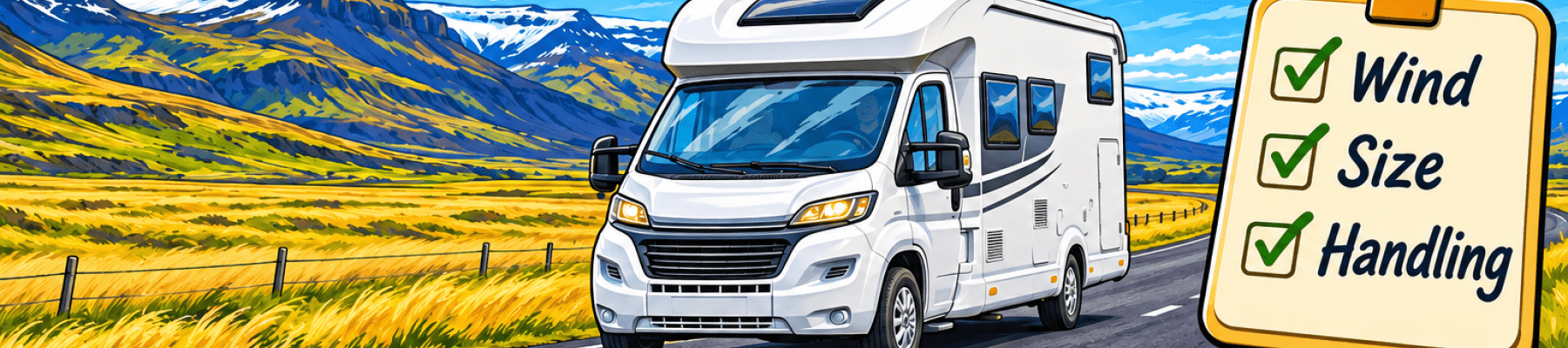
Driving a Motorhome in Iceland for the First Time: Wind, Size and Handling
Tips for driving a motorhome in Iceland for the first time: size and handling, our 15 m/s wind rule, narrow roads, gravel and overnight stops.
Last updated: 24 November 2026
Plenty of people rent a motorhome in Iceland without ever having driven anything bigger than a family car. The size takes a little getting used to, but the bigger change is how a tall, heavy vehicle behaves in Icelandic wind, on narrow roads and in tight spaces.
Speed limits, road signs and single-lane bridges are the same for any vehicle, and they're in our guide to driving in Iceland. This post is about the motorhome itself.
Who Can Drive Our Motorhomes
The minimum age for our motorhomes is 25, and every driver needs to have held their licence for at least 24 months. Licences printed in Latin characters are accepted. If yours isn't, bring an International Driving Permit as well.
Our motorhomes weigh no more than 3.5 tonnes, so a standard car licence (category B) is enough to drive them.
Most of our motorhomes are manual. Only Búrfell and Baula are automatic, so book early if you can't drive a manual. If you can but you're out of practice, read our guide to manual motorhomes first.
Getting Used to the Size
Our largest motorhomes, the six-berth ones, are about 7.4 metres long and 3.4 metres high. The others are 5.4 to 6.5 metres long and up to 2.85 metres high. You notice the length when turning and parking, and the height under anything with a roof, such as a petrol station canopy or a car park barrier. Check the height of your motorhome before you set off and keep it in mind.
Turning and Reversing
Take corners wider than you would in a car, because the rear wheels cut inside the line of the front ones. The back of a motorhome also extends well past the rear axle, so when you turn sharply, the rear swings out. Watch for posts, fuel pumps and other cars when pulling out of a tight space.
When reversing, ask a passenger to get out and guide you. Agree on hand signals first, and stop if you can't see them in your mirrors.
Braking and Hills
A loaded motorhome takes longer to stop than a car. Leave a bigger gap to the vehicle in front, and brake earlier for corners and junctions. On long descents, shift to a lower gear and let the engine slow you down instead of riding the brakes.
Before You Drive Off
Close the cupboards, the fridge and the roof vents, and put away anything loose. A pan sliding off the hob on the first corner is a common way to learn this. Check that the entry step is in and the door is locked.
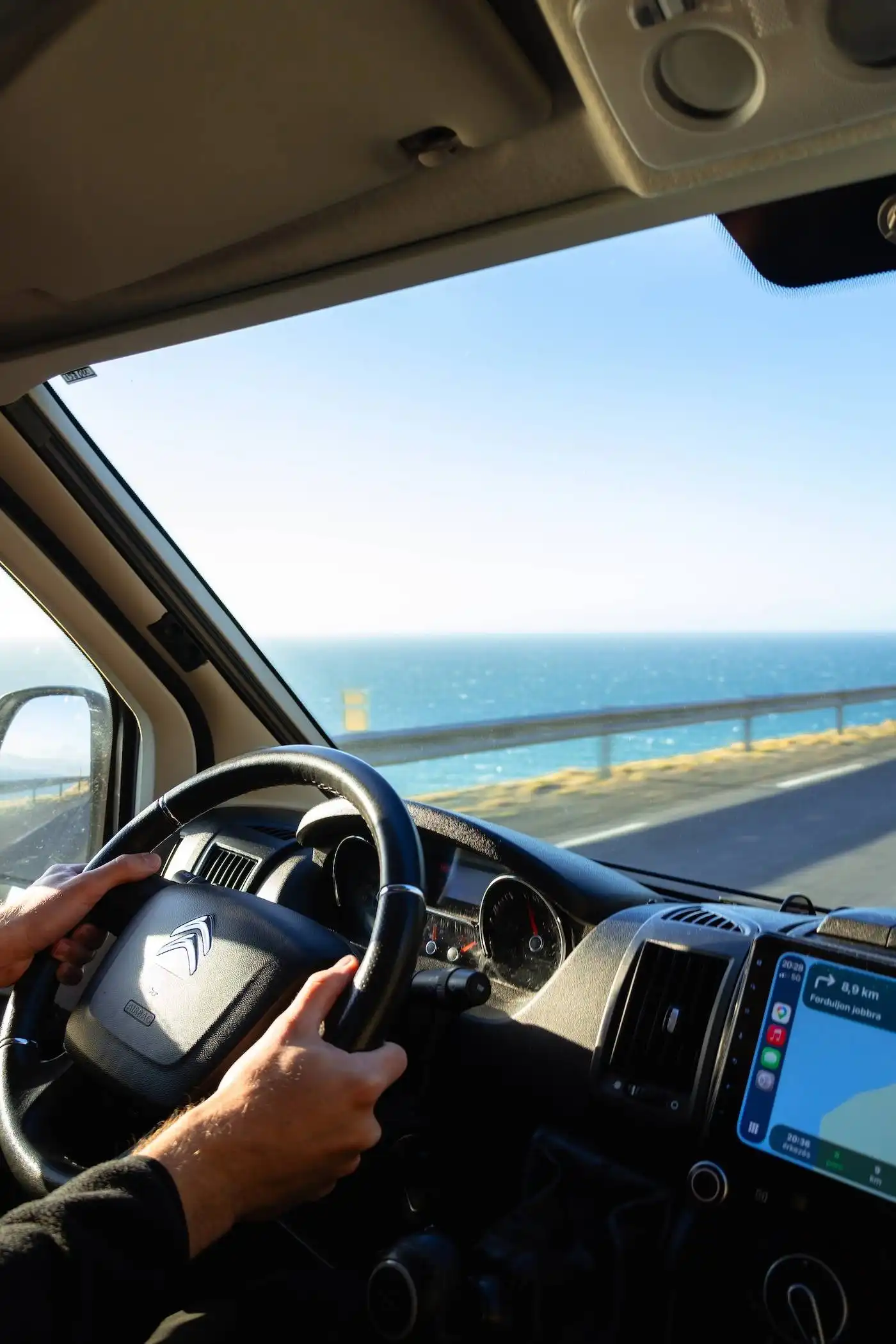
Wind Is the Biggest Difference
The side of a motorhome is a large flat surface, and a strong gust can push it sideways across the lane. It happens most on open stretches of road, on bridges and where the wind funnels between mountains.
Under our rental terms, our motorhomes may not be driven when the wind speed reaches 15 m/s (54 km/h or 33 mph). Damage caused by driving in those conditions isn't covered by insurance. You can read the details in our terms and conditions.
How to Check the Wind
The Icelandic Met Office forecast shows wind speed in metres per second, and it also issues yellow, orange and red weather warnings. Gusts can be much stronger than the average speed in the forecast. For conditions along your route right now, look at the road weather stations on Traffic Info, which show the current wind speed and the strongest gusts.
Some stretches of Route 1 are known for strong gusts, including Kjalarnes just north of Reykjavík, Hafnarfjall near Borgarnes, the road below Eyjafjöll near Seljalandsfoss and Skógafoss, and Öræfi between Skaftafell and Jökulsárlón. Off Route 1, Snæfellsnes can get very windy too.
If the Wind Picks Up
Don't push on to reach your campsite. Pull into a parking area or a campsite and wait until the wind drops, which often takes a few hours. Never stop on the road itself. If you can, park with the front of the motorhome facing into the wind so it rocks less.
Be careful with the doors. Open the cab doors and the living area door with both hands, because a gust can catch a door and bend it back on its hinges. Damage to the door structure caused by wind isn't covered by our insurance.
Narrow Roads and Gravel
Much of Route 1 is a two-lane road with little or no hard shoulder. Keep to the right, and slow down when meeting buses and lorries. The edge of the road can be soft, especially in spring, so don't pull onto the verge to let someone pass. When a queue builds up behind you, use the next lay-by to let faster traffic go by.
On gravel roads, slow down. Loose stones make the motorhome slide more easily on corners, and passing cars can throw stones at the windscreen. Our motorhomes are 2WD and aren't allowed on F-roads, F-249 or any river crossing. Driving on a closed road is also prohibited, with a fine of 100,000 ISK.
Fuel, Parking and Overnight Stops
Check whether your motorhome takes diesel or petrol before you fill up. It's marked on the vehicle. Outside towns, many petrol stations have no staff, and the pumps usually need a card with a PIN (more on that in our gas stations guide).
Parking a motorhome in central Reykjavík is hard. Leave it outside the centre and walk or take the bus in. We've covered where to park a campervan around the country in a separate post.
Overnight, you'll need a campsite. Wild camping isn't permitted in most of Iceland, but there are more than 200 registered campsites, and our pick of the best campsites by region is a good place to start.
Plan Shorter Driving Days
A motorhome is slower than a car on hills and through bends, and you'll stop more often. Add extra time to the driving times your map app gives you, and plan your days so the longest drives happen in daylight. Most people find three or four hours of driving a day is enough. Headlights must be on at all times in Iceland, day and night.
If Something Goes Wrong
In an emergency, call 112. For breakdowns or any problem with the motorhome, call our 24/7 assistance line on +354 823 1566. If you're involved in an accident, notify the police and get a report for the insurance.
When you land at Keflavík, take our free airport shuttle to the office to collect your motorhome. To compare sizes, seats and gearboxes before you book, have a look at our fleet.